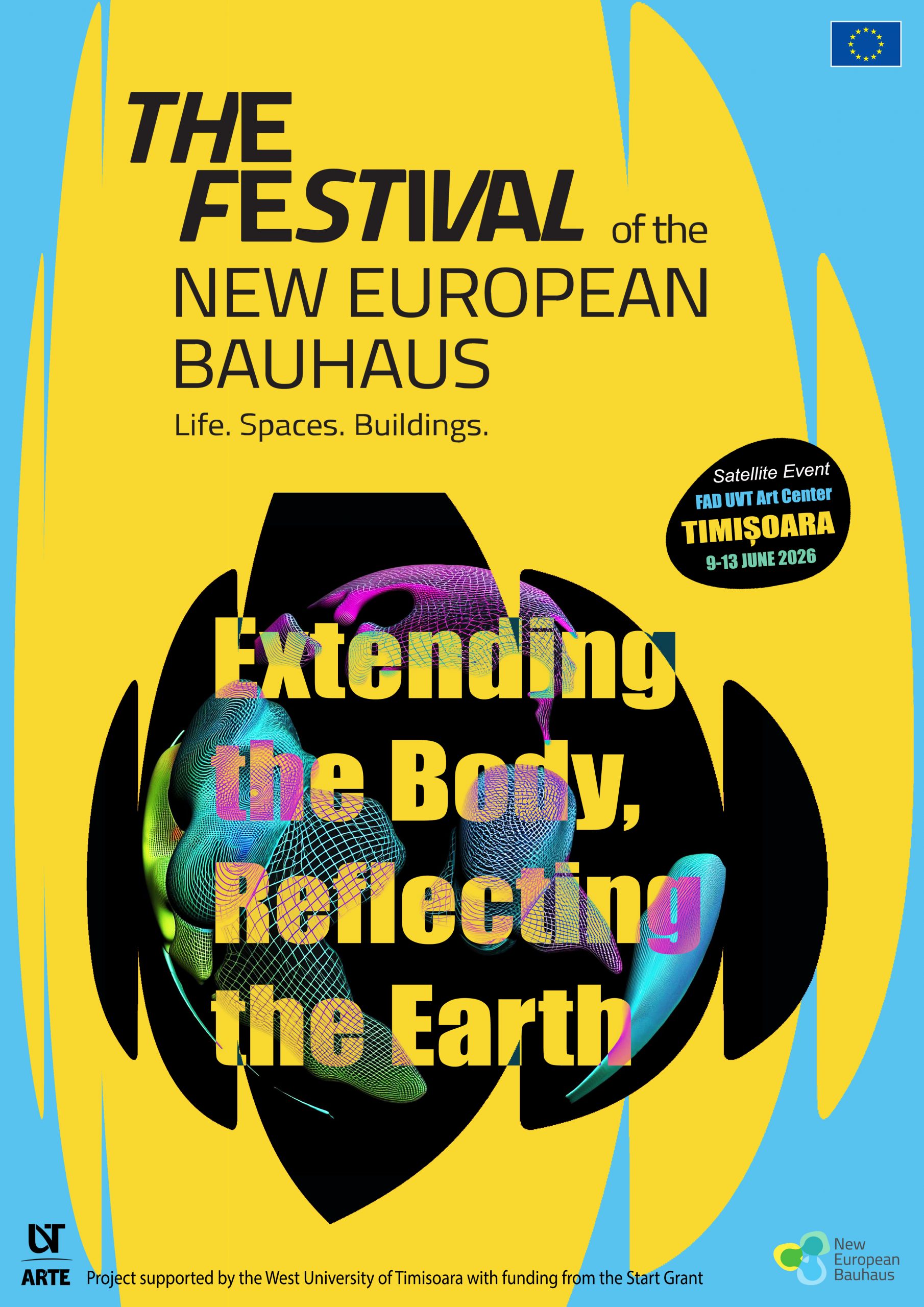
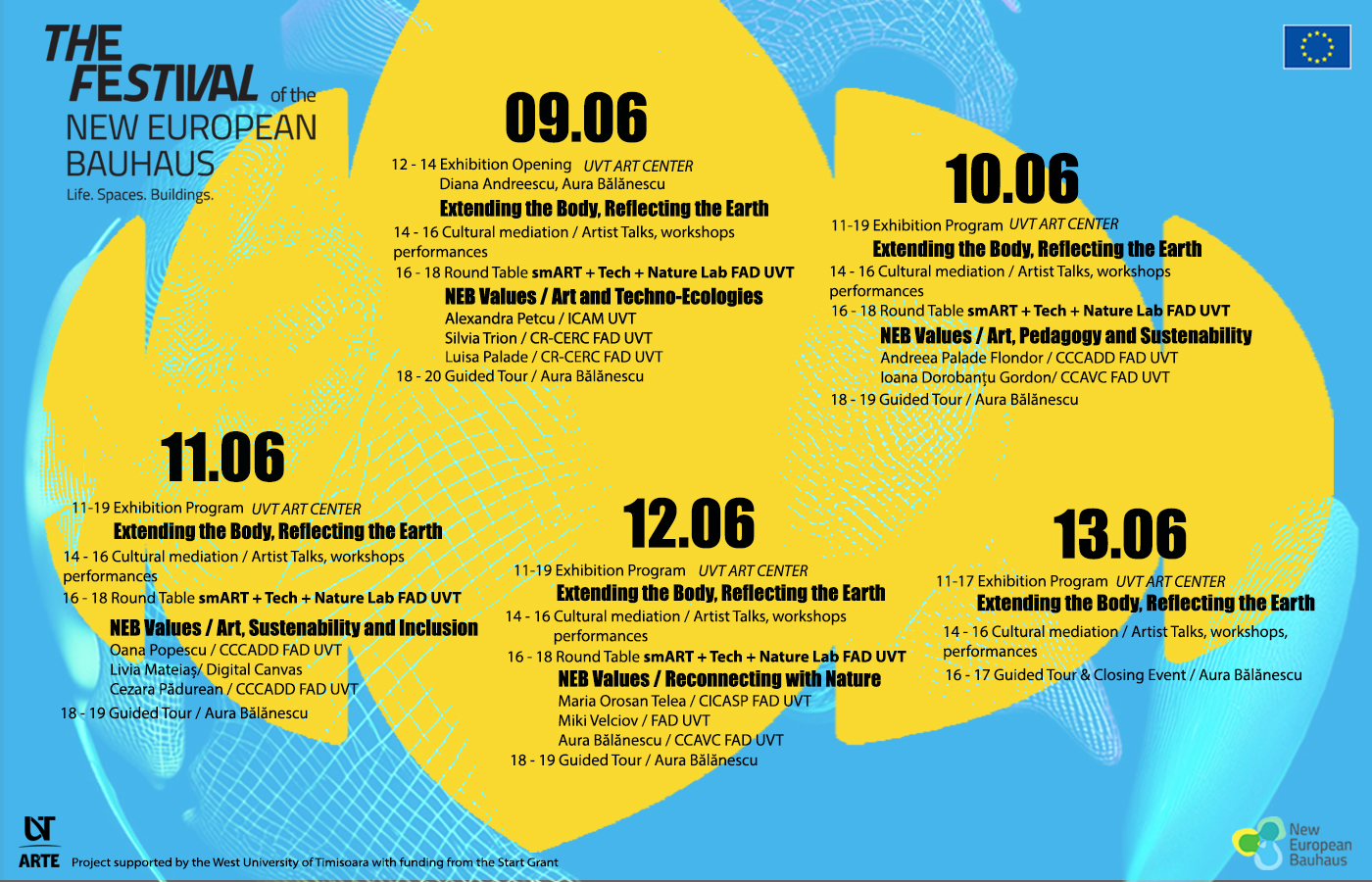
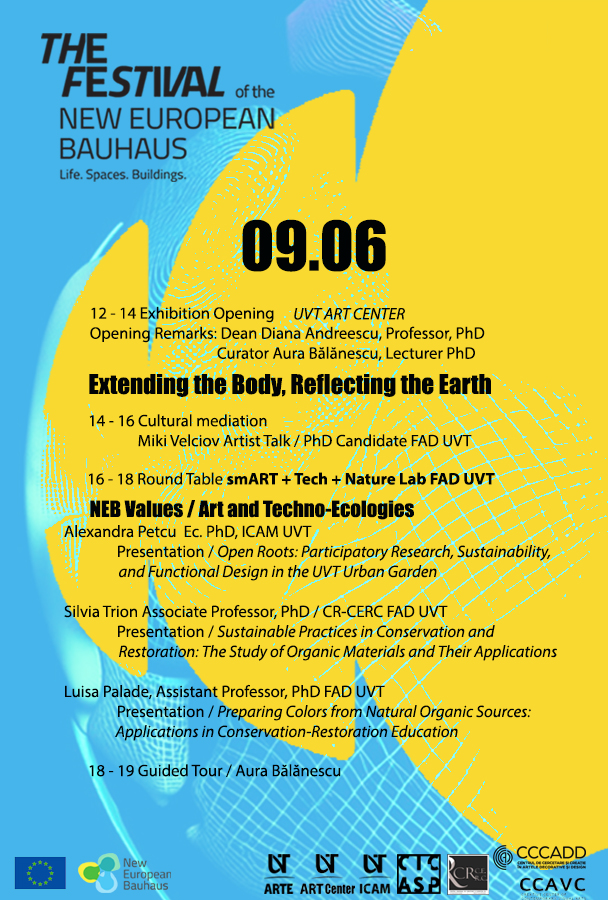
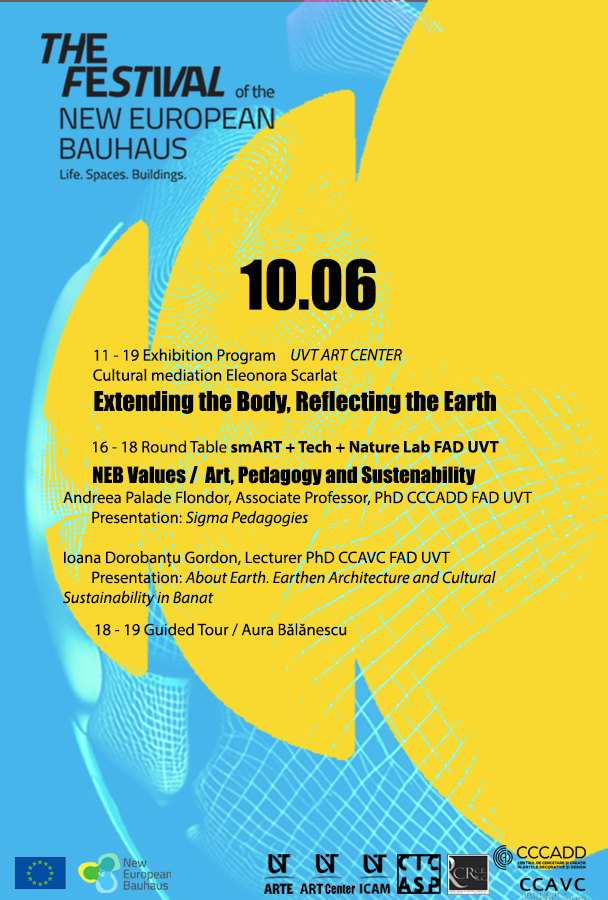
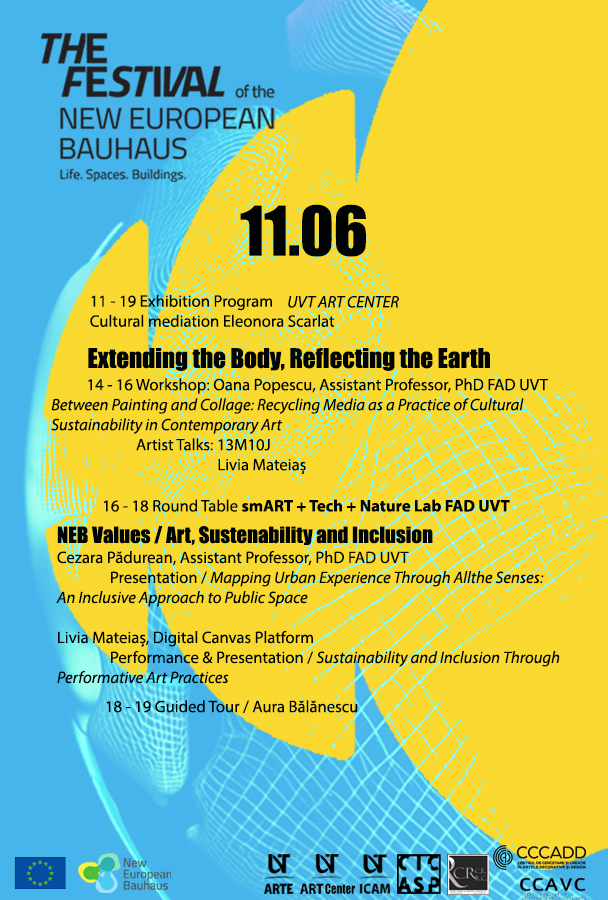
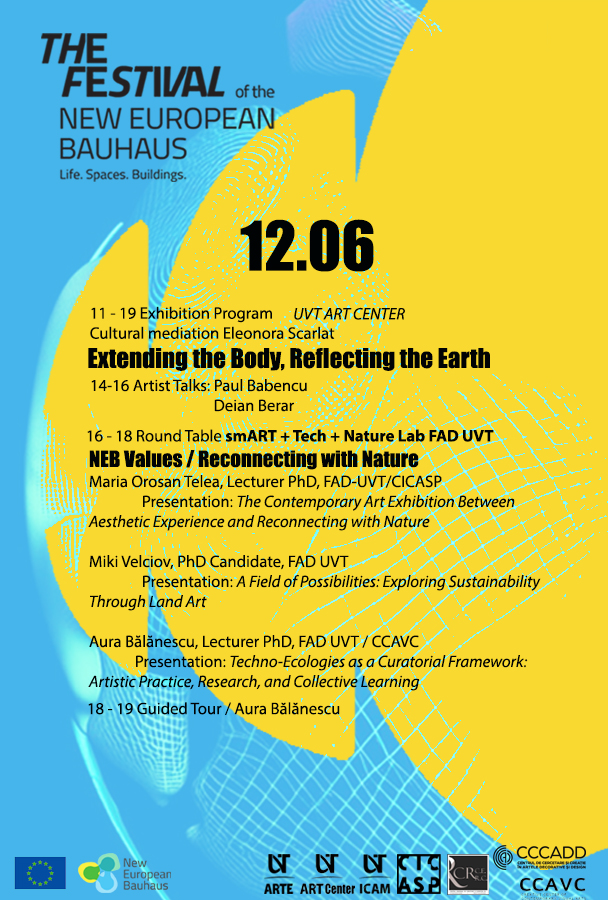
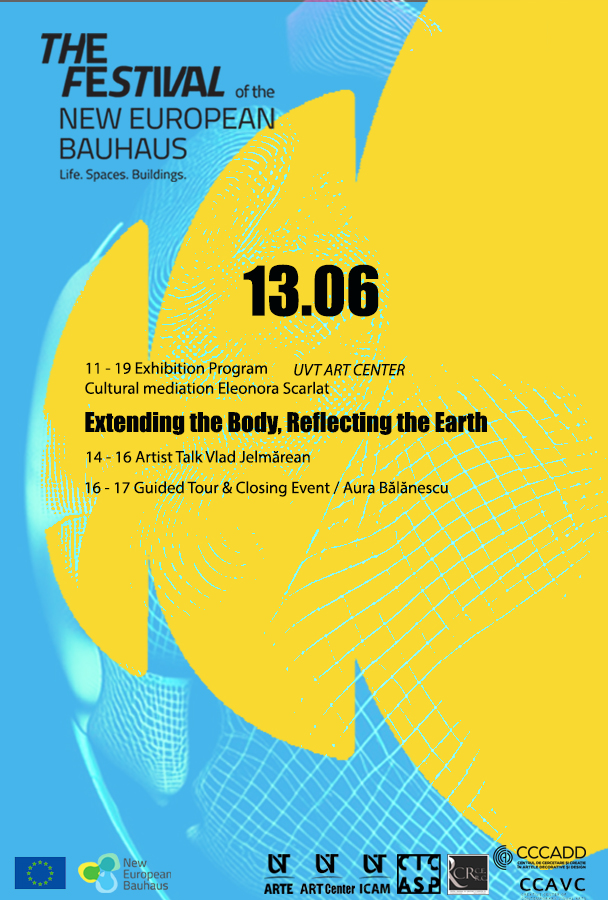
Extending the Body

Reflecting the Earth

A project powered by Faculty of Arts and Design, West University of Timisoara, Center for Research and Creation in Decorative Arts and Design (CCCADD), Creative Center of Contemporary Visual Arts (CCAVC), and UVT Art Center

Concept

The exhibition Extending the Body, Reflecting the Earth is conceived as a living constellation—an experiential ecosystem where bodies, technologies, and planetary atmospheres co-evolve as interdependent agents of sensing, memory and imagination. Rather than framing the artworks as discrete media installations, the exhibition understands them as relational nodes whose connections produce new forms of ecological awareness. Together, they explore how perception can be expanded, how presence can be recalibrated, and how technological systems can operate not as instruments of control, but as membranes of attunement and care.

The notion of extending the body begins from the premise that the body is not a closed biological unit but a porous interface—an organ of resonance, orientation and relationality. Across the exhibition, breath, movement, gaze, atmospheric disturbance, symbolic interpretation, intuitive gesture, and algorithmic patterning become modes of expanded embodiment. Technologies such as atmospheric sensing, computer vision, AI-based image synthesis, voice/breath detection, and dynamic simulation are not treated as external tools, but as participants in ecological co-creation. Each installation extends the body outward—toward air, water, light, data, symbols and speculative environments—situating human presence within a broader continuum of earthly processes.

Reflecting the Earth introduces a reciprocal movement. Instead of projecting human meaning onto the planet, the exhibition asks how the Earth reflects—through hydrological instability, atmospheric turbulence, cultural resonance, environmental signals, collective identity, and the speculative futures encoded in emergent systems. The installations propose different modes of ecological reflection: the fragility of water cycles (H₂O Transition), the volatility of air as medium (Desert Storm, Breathing Fields), the shifting significance of symbols (Circle of Power), the intuitive mapping of embodied gestures (Constellating Intuition), the communal identity embedded in shared presence (Feature Fusion), and the generative potential of algorithmic worlds (What If? Worlds Reimagined). These reflections reposition the Earth not as passive background, but as an active interlocutor in the meaning-making process.

The exhibition aligns with the subtheme Charting Constellations – Digital Geographies, but also with Eco-Tech Futures – Ecologies of Place – to reveal them as interdependent ecologies, rather than isolated conceptual territories. The works form a network of sensory and conceptual connections, mirroring the structure of a constellation in which each node gains meaning through its relationship to the others. Technologies here are approached as techno-ecological agents—capable of facilitating relationality rather than dominating it. Visual data becomes a material for empathy, computation becomes a field for shared imagination, and interactivity becomes an ecology of care. By engaging visitors as co-creators—where breath becomes landscape, movement becomes turbulence, faces become communal images, gestures become constellations, and presence influences speculative ecosystems—the exhibition positions perception itself as an ecological act.

Ultimately, Extending the Body, Reflecting the Earth proposes that media art can cultivate new forms of planetary imagination. By linking embodied experience, environmental sensibility, intercultural reflection and technological mediation, the exhibition invites audiences to inhabit a constellation of shared vulnerability and possibility. Curating becomes an ecological practice, and experience becomes a site where bodies, atmospheres and technologies learn to sense—and to reflect—the Earth together.
CONTEXT

Extending the Body, Reflecting the Earth is a multidisciplinary art and culture event conceived as a participatory platform where art, technology, ecology and education intersect. Designed as a living constellation of installations, talks and guided experiences, the event explores how human bodies, technological systems and natural environments can be reconnected through sensory awareness, collective imagination and ecological care.

The event’s main objective is to foster new forms of ecological consciousness by engaging participants in embodied, aesthetic and inclusive experiences. Through media art installations, workshops and public discussions, the event invites audiences to reflect on their relationship with the environment, with technology and with one another. Rather than addressing sustainability only at a conceptual or informational level, the project emphasizes lived experience, perception and co-creation as essential tools for rethinking our role within fragile planetary systems.

Rooted in the values of the New European Bauhaus, the event brings together emerging artists, educators, researchers and the wider public to explore sustainability, inclusiveness and beauty as interconnected dimensions of contemporary life. It positions art not only as a form of expression, but as a space for dialogue, learning and social transformation. By translating complex ecological and technological challenges into accessible sensory encounters, the event encourages participants to imagine more caring, resilient and interconnected futures, grounded in shared responsibility, long-term thinking and collective action.

The event also functions as an educational and cultural bridge between academic research, artistic practice and civic engagement, contributing to a broader European conversation on how creativity, culture and education can actively support ecological transition and social cohesion.

Initiated and hosted by the Faculty of Arts and Design of the West University of Timisoara, the event builds on an institutional context with a strong tradition in experimental art, media practices and interdisciplinary education. Located in a region shaped by industrial, technological and cultural transformation, the faculty has developed a distinctive approach that bridges artistic heritage, technological experimentation and socially engaged pedagogy.

Participation in an international framework such as the New European Bauhaus represents a meaningful opportunity to connect local cultural knowledge and emerging artistic practices with wider European conversations on sustainability, inclusion and aesthetics. The event positions Timisoara and its creative community as active contributors to the European cultural ecosystem, emphasizing the role of art education and research in shaping long-term, value-driven transformation.

artworks

Extending the Body, Reflecting the Earth brings together six media installations and a screening gaming art selection that investigate how bodies, technologies, and ecological processes co-produce new forms of perception and meaning. Conceived as an interconnected constellation, each artwork acts as an ecological node—activating a distinct modality of sensing while remaining in dialogue with all the others.

Artwork 1: Desert Storm: Dust Negotiating Humanity

Artist: Paul Babencu

Technical description: Immersive atmospheric installation

Dimensions: 400 x 300 x 300 cm

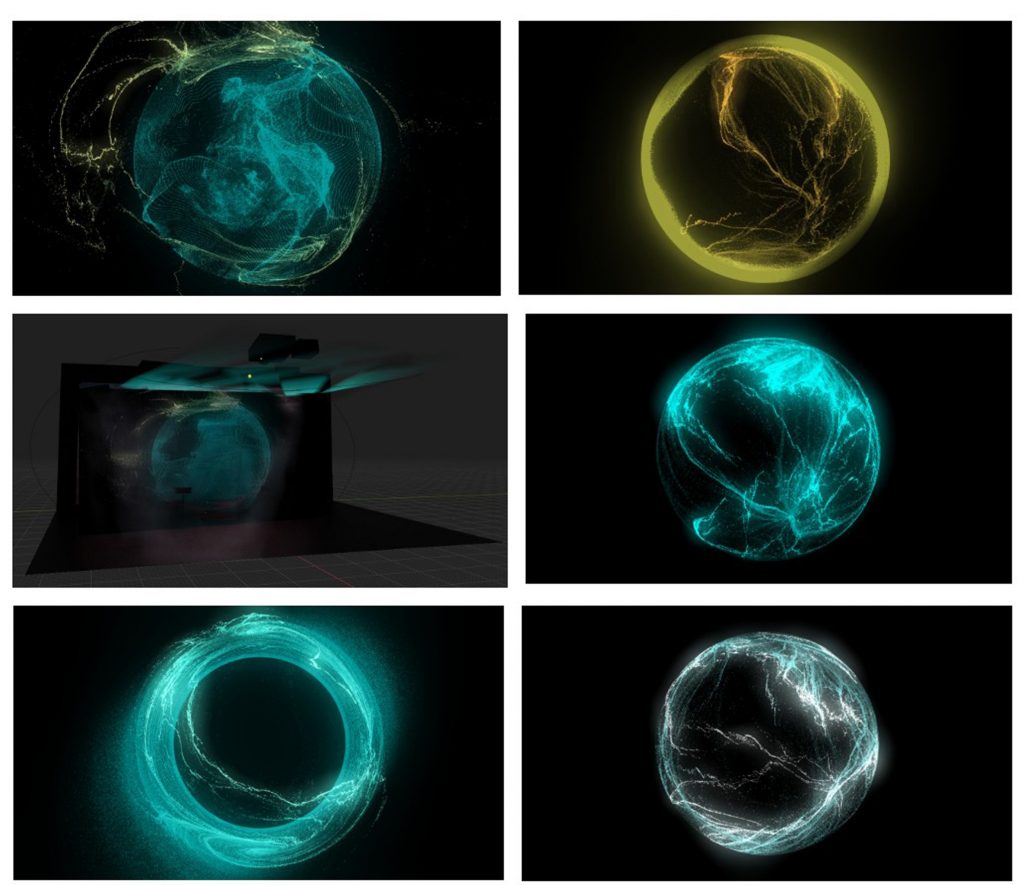
Desert Storm: Dust Negotiating Humanity constructs a responsive atmospheric environment in which artificial turbulence becomes a perceptual interface. Through haze, light, sound, and real-time sensing, the installation transforms air into an active medium that reacts to the movement and presence of participants, generating a dynamic field of fluctuation and instability.

Expanding this atmospheric condition, the work integrates AI-generated narration and procedural visual systems that evoke cosmic and cellular formations—black holes, planetary structures, and micro-organic patterns—not as distant representations, but as processes translated into perceptual experience. These elements introduce a multi-scalar dimension in which bodily sensing becomes entangled with broader material and temporal continuities.

Rather than unfolding as a linear journey, the installation operates as a responsive system in which participants navigate a shifting environment shaped by interaction, data, and algorithmic modulation. Through gestures, movement, and optional controller-based input, visitors influence the intensity, rhythm, and transformation of visual and atmospheric conditions, or alternatively relinquish control to the autonomous orchestration of the system.

Within this framework, dust emerges as an implicit material agent—linking atmospheric turbulence to particulate processes unfolding across scales, from environmental conditions to deep temporal and cosmic formations. The work reflects on humanity’s position within these dynamic systems, not as an external observer, but as a participant embedded in processes of creation, transformation, and instability.

Balancing between awe and critical reflection, the installation addresses the tension between technological expansion and ecological fragility. It raises the question of whether human systems evolve through collision, acceleration, and fragmentation—or through forms of coordination, resonance, and shared balance.

In this unstable and responsive environment, perception is continuously reconfigured, and humanity itself appears not as a fixed identity, but as a condition negotiated through interaction with atmospheric, technological, and material forces.

Artwork 2: H₂O Transition

Artist: Livia Mateiaș

Technical description: Light-based multimedia installation

Dimensions: 400 x 400 x 300 cm

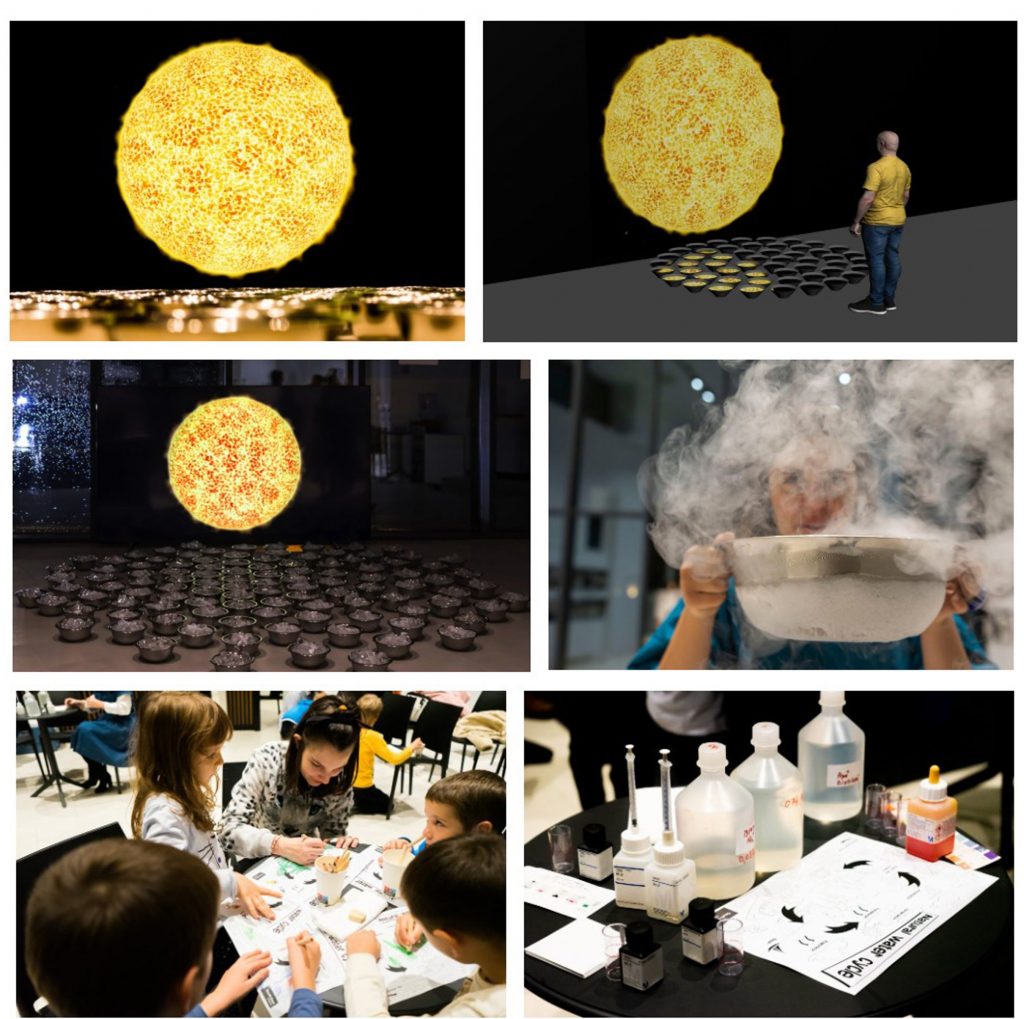
H₂O Transition constructs a perceptual environment in which water is encountered as a dynamic and relational system rather than a stable resource. Through light, reflection, and material containment, the installation stages the transformation of water across its multiple states—liquid, vapor, ice, and reflective surface—revealing hydrological processes as unstable and continuously shifting.

Within this environment, water operates as a material agent that mediates between body, perception, and planetary conditions. As visitors move through the space, reflections fragment, recombine, and drift, generating a fluid cartography of presence in which perception emerges through interaction with light and surface.

Extending beyond representation, the work situates hydrological instability within a broader ecological continuum. Water is not presented as an isolated element, but as part of interconnected processes linking atmospheric conditions, environmental change, and temporal transformation.

Participants become embedded within this shifting field, where sensing and being sensed unfold simultaneously. In this context, the installation proposes a negotiation between human presence and hydrological systems, reframing water as a co-present ecological agent through which fragility, transformation, and interdependence become perceptible.

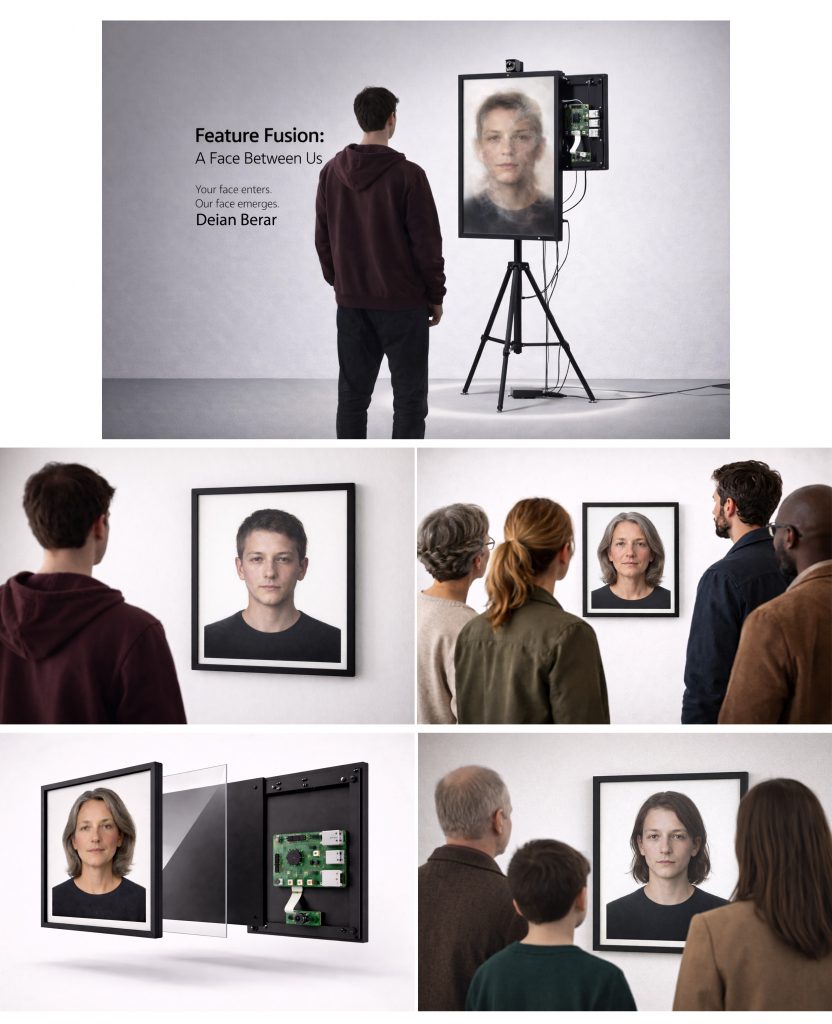
Artwork 3: Feature Fusion. A Face Between Us

Artist: Deian Berar

Technical descripition: AI-driven participatory installation

Dimensions: 200 x 200 x 200 cm

Feature Fusion constructs a responsive computational environment in which identity emerges as a dynamic and relational process. Through real-time image capture and AI-based synthesis, the installation generates an evolving collective portrait that continuously recombines the facial features of participants.

Within this system, visual data becomes a material agent—fluid, unstable, and shared. Rather than preserving individual identity, the algorithm dissolves and reconfigures it, producing a shifting composite that reflects the presence of multiple bodies across time.

The installation repositions machine vision from a tool of surveillance to a field of relational becoming. Identity is no longer fixed or owned, but negotiated through interaction between human presence and algorithmic processes.

Operating across scales, the work connects the immediacy of facial recognition with broader questions of collective existence and shared futures. Participants encounter themselves not as isolated individuals, but as part of an emergent system in which boundaries between self and other, human and machine, become increasingly permeable.

In this evolving feedback loop, humanity appears as a continuously recomposed condition—formed through data, interaction, and the co-presence of others.

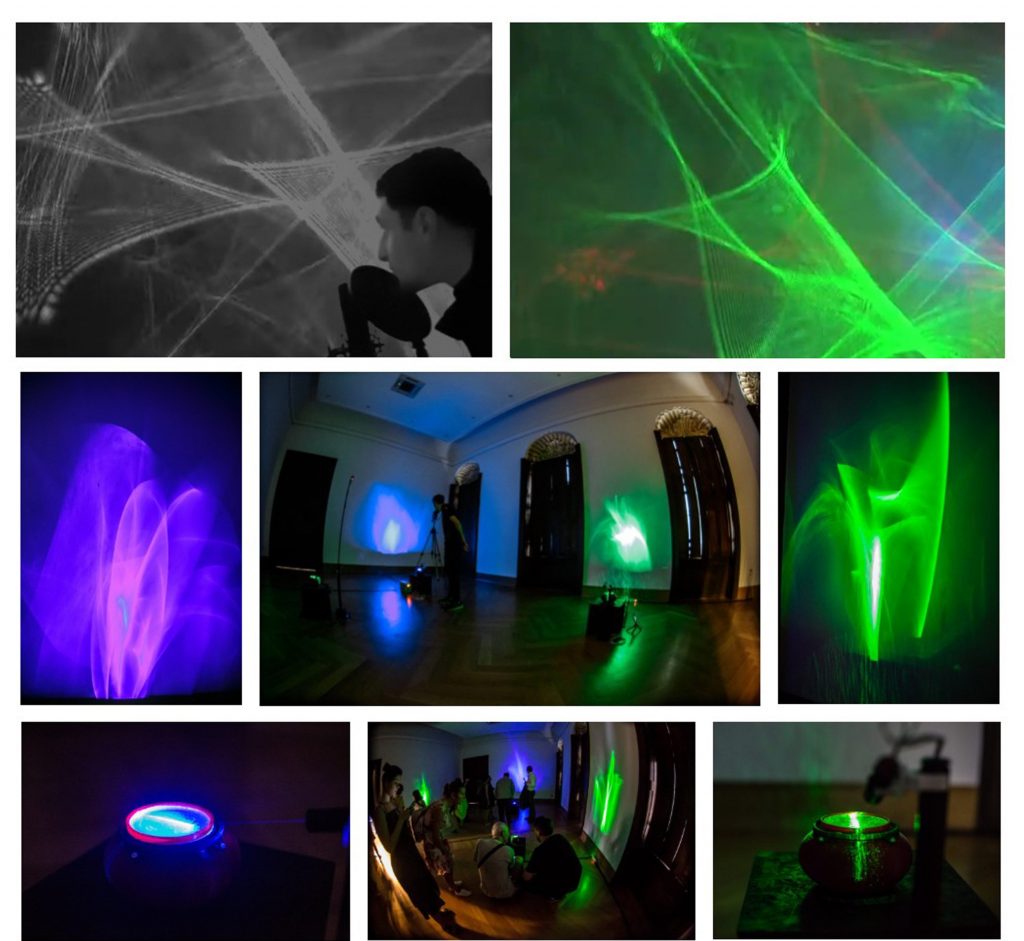
Artwork 4: Breathing Fields

Artist: Vlad Jelmărean

Technical description: Breath-driven cymatic laser projection

Dimensions: 300 x 400 x 300 cm

Breathing Fields constructs an atmospheric environment in which respiration becomes a spatial and perceptual force. Using sensors, haze, and cymatic laser projections, the installation translates breath and voice into dynamic formations of light that expand, contract, and dissolve in real time.

Within this system, breath operates as a material agent that connects individual bodies to shared atmospheric conditions. Each exhalation generates temporary spatial configurations, transforming air into a responsive medium that records and amplifies presence.

The installation reveals respiration as a multi-scalar process—linking intimate bodily rhythms with broader atmospheric dynamics. Breath becomes both a biological function and an ecological interface, situating the body within a continuum of air, environment, and collective presence.

Participants enter a feedback system in which sensing and emission are inseparable. In this context, the work stages a negotiation between individual expression and shared environment, reframing breathing as a form of ecological inscription.

Through this process, the installation positions atmosphere as a living field in which bodies do not simply exist, but continuously co-create spatial and perceptual conditions.

Artwork 5 — Circle of Power

Artist: Miki Velciov

Circle of Power investigates how symbols shape collective perception. A circular array of chromatic elements responds to the visitor’s position, revealing patterns reminiscent of national flags—yet abstracted beyond specific iconographies. Instead of fixed identifiers, the installation presents symbols as emergent constellations of color and form. Visitors engage in perceptual negotiation: meanings shift as perspectives shift. Through this relational dynamic, Circle of Power encourages reflection on cultural memory, symbolic power, and the fluidity of identity within intercultural environments.

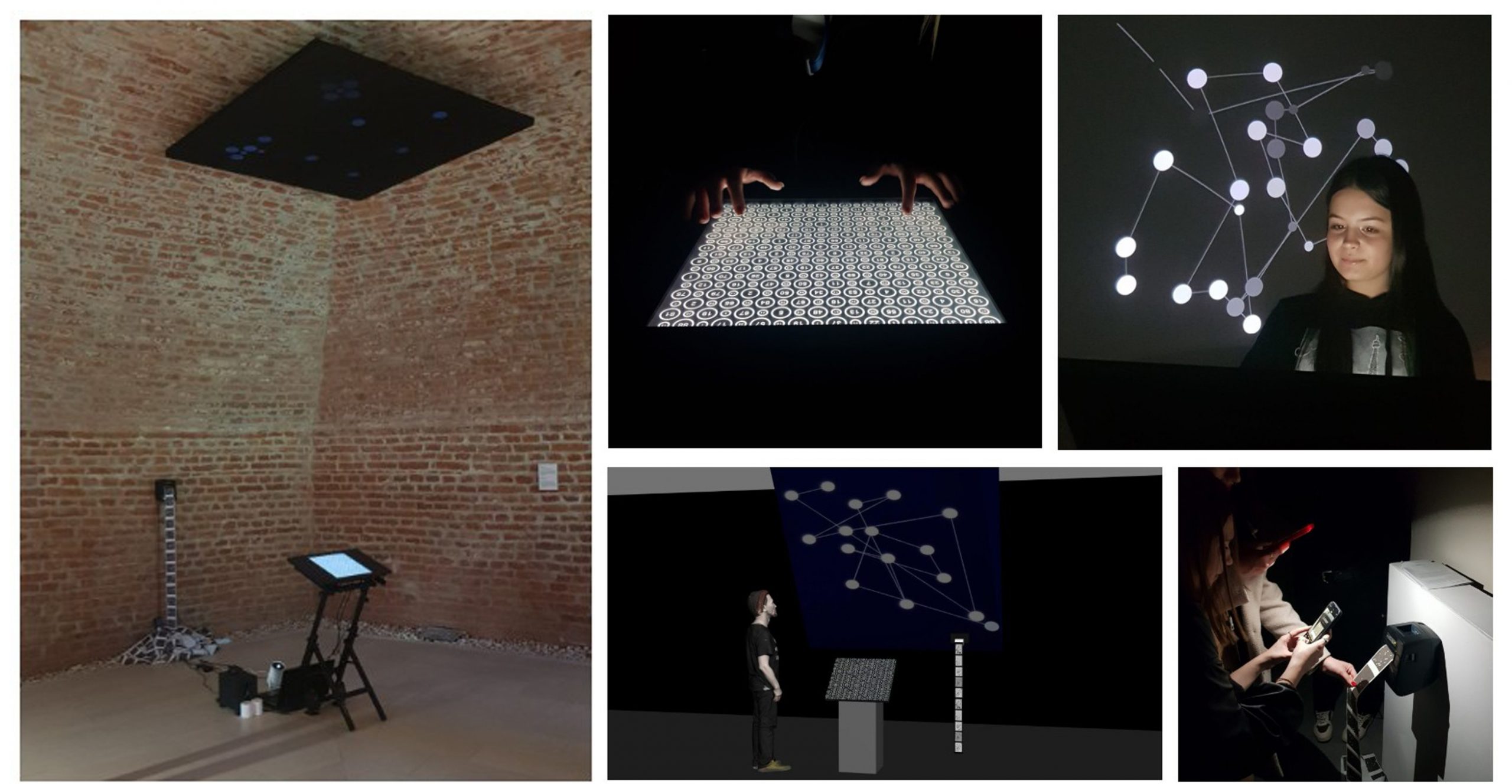
Artwork 6: Constellating Intuition

Artist: Marius Jurca / 13m10j

Technical description: Interactive gesture-based system

Dimensions: 300 x 350 x 300 cm

Constellating Intuition constructs an interactive system in which gesture becomes a generative interface between body, space, and abstract structure. Through real-time tracking, subtle hand movements are translated into dynamic constellations of light that cluster, disperse, and reorganize into ephemeral configurations.

Within this environment, gesture operates as a material agent that produces form through movement. The installation transforms intuition from an internal cognitive process into an externalized, spatial phenomenon—emerging relationally through interaction with the system.

The resulting constellations evoke both mnemonic diagrams and cosmic structures, linking embodied action with broader patterns of organization and emergence. Rather than representing the cosmos, the work activates a shared field in which micro-gestures resonate with macro-structures.

Each configuration is both transient and recordable, allowing fleeting moments of perception to leave traces. In this process, the installation stages a negotiation between control and emergence, intention and system behavior.

Participants engage with a dynamic environment in which knowledge is not predefined, but generated through interaction—positioning intuition as a relational process unfolding across body, system, and space.

Artwork 7: What If? Worlds Reimagined

Artists:Timeea Dragomir, Cristina Iordache, Tudor Predescu

Technical description: Interactive gesture-based system

Dimensions: 200 x 200 x 300 cm

What If? Worlds Reimagined is an interactive speculative environment in which participants navigate evolving virtual ecosystems. Combining game-based interaction, 3D worlds, and audiovisual simulation, the work explores how futures are imagined and negotiated through human–machine interaction. Positioned between gaming, concept art, ecological thinking, and digital storytelling, the installation frames speculation as a relational process shaped by uncertainty, agency, and shared imagination.

Interactive multimedia installation combining game-based interface, 3D environments, and audiovisual projection. The project includes digital prototypes, 3D models, animations, and optional VR/AR elements. Visitors interact through a custom interface, navigating speculative environments in real time.

Artists

The artists participating in Extending the Body, Reflecting the Earth form an interdisciplinary collective of emerging practitioners, composed of students (Paul Babencu, Deian Berar, Timeea Dragomir, Cristina Iordache, Tudor Predescu, Miki Velciov) and alumni (Livia Mateiaș, Marius Jurca / 13m10j, Vlad Jelmărean) of the Faculty of Arts and Design, West University of Timisoara. Their backgrounds span media art, installation, sound, performance, interactive systems, experimental image-making, and computational practices oriented toward speculative futures. They share an interest in ecological perception, sensory experimentation, and the poetic potential of technological environments.

curator

Aura Bălănescu is a media artist, curator and researcher whose practice explores intersections of art, technology, and ecological thinking. As a lecturer at the Faculty of Arts and Design, West University of Timișoara, she develops research-based pedagogies integrating interactive systems, biofeedback sensors, AI-generated structures, and atmospheric sensing. Through her affiliation with Tehnoarte Association, she focuses on sensory environments and expanded embodiment, treating artistic practice as a living system where bodies, materials, and technologies co-evolve.

Her recent curatorial projects, Sensing the Data, Practicing the Care selected at Isea Dubai 2026, or Techno-Ecologies for a Fragile Earth exhibited at Ars Electronica Campus Festival 2025, explored global ecological vulnerability through interactive installations combining perception, environmental data, and technological reflection. Across her practice, she advocates for art as an interface of ecological empathy and for media technologies as agents capable of cultivating care, awareness, and relationality.

Team

Dean Prof. Dr. Diana Andreescu / A project powered by Faculty of Arts and Design, West University of Timisoara, Center for Research and Creation in Decorative Arts and Design (CCCADD), Creative Center of Contemporary Visual Arts (CCAVC), and UVT Art Center.

Coordinating team: Lect. univ. dr. Aura Bălănescu, Conf. univ. dr. Ion Gherman, Conf. univ. dr. Alexandru Bunii, Lect. univ. dr. Lucian Ciorba

Acknowledgements

The proposal was supported by the West University of Timișoara with funding from the Start Grant project.

resources

  • All Posts
  • Exhibitions

Partners

Tue ‒ Thu: 05pm ‒ 07pm

Splaiul Peneș Curcanul nr. 4-5, clădirea Azur, etaj 1, studio 29, Timișoara